Can You Look at a Lunar Eclipse? How to Watch It With Eclipse Guide (No Glasses Needed)
If you’ve ever typed “can you look at a lunar eclipse without glasses”… we don’t judge you. The internet is full of eclipse questions, and for good reason: nobody wants to accidentally damage their eyesight.
Here’s the simple truth: lunar eclipses are safe to observe with the naked eye. No special eclipse glasses, no filters, no dramatic warnings. Just the Moon slowly sliding into Earth’s shadow — and looking cooler because of it.
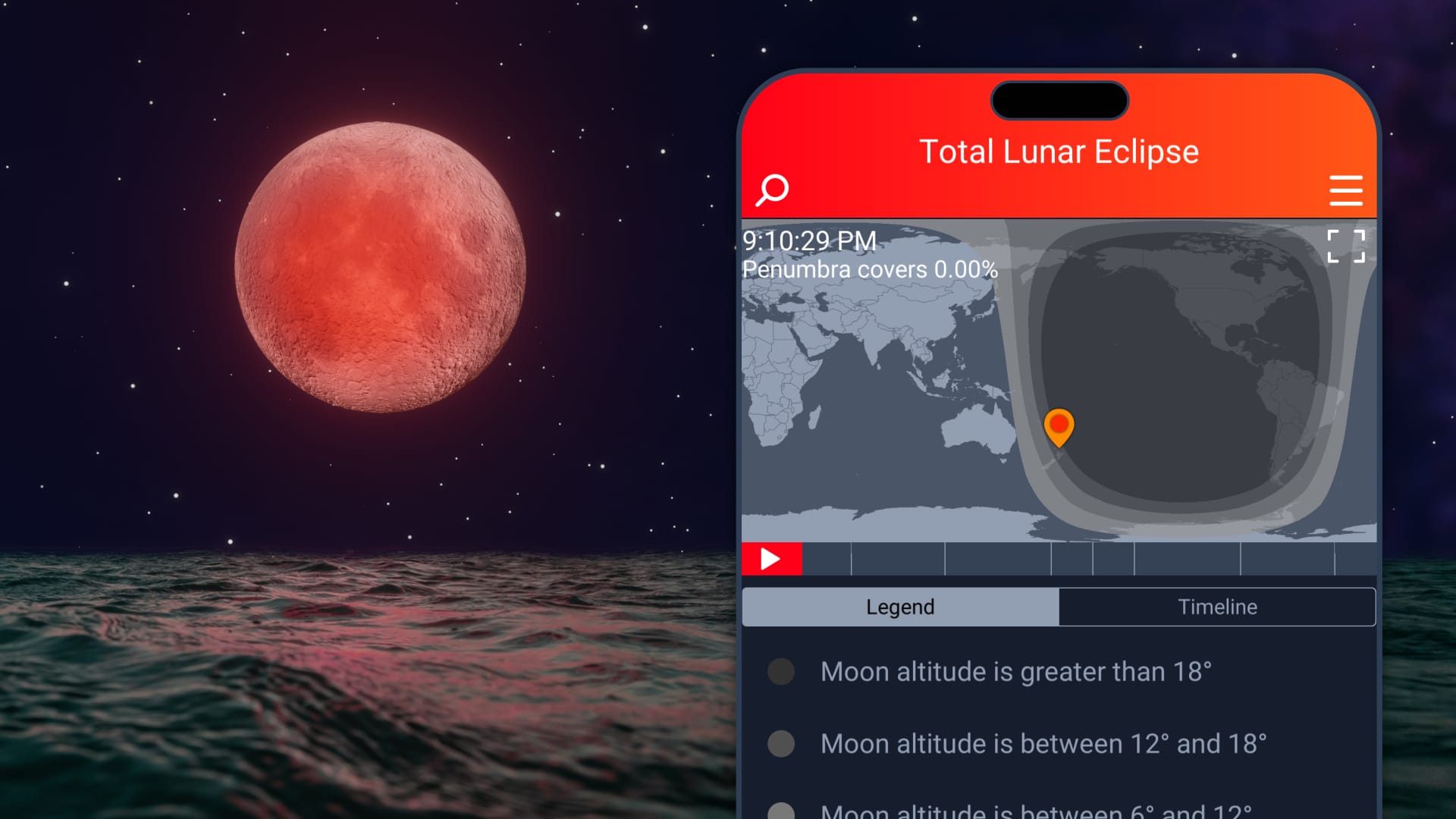
The real challenge isn’t your eyesight — it’s timing and planning. When does an eclipse start in your location? When is the maximum eclipse? What will an eclipse look like? That’s exactly why we made Eclipse Guide — a dedicated app for eclipse viewing. It shows whether the eclipse is visible from your location, gives the exact times for every phase, and sends notifications so you don’t miss the best part.
And with a total lunar eclipse (“Blood Moon”) coming on March 2–3, 2026 (depending on your time zone), this guide will be especially handy.
Below is everything you need to know — whether you’re watching with the naked eye, binoculars, or a telescope — plus a quick Eclipse Guide walkthrough to make sure you catch the peak.
Key takeaways:
- Yes, you can look at a lunar eclipse directly — it’s safe for your eyes.
- No, you don’t need eclipse glasses (those are for solar eclipses).
- Binoculars and telescopes are safe to use and can improve the view.
- The “best part” is usually the partial phase and totality (if it’s a total lunar eclipse).
- Use the Eclipse Guide app for exact phase times and visibility.
What is a lunar eclipse (and why it can’t damage your eyes)
A lunar eclipse happens when Earth moves between the Sun and the Moon, and Earth’s shadow falls on the Moon. The key point is this:
You’re looking at the Moon, not at the Sun.
That’s why the rules are completely different from a solar eclipse. During a solar eclipse, you must use proper eye protection because you’re looking directly at the Sun. During a lunar eclipse, you’re simply observing the Moon, which only reflects sunlight and is safe to view with the naked eye. In fact, during the main phases, the Moon often looks dimmer than usual, which makes it even more comfortable to watch.
Is it safe to watch a lunar eclipse?
Yes. 100% yes.
You can look at a lunar eclipse without eclipse glasses, sunglasses, welding masks, or any other creative DIY solutions. In fact, eclipse glasses made for the Sun will usually make the Moon so dark you’ll see… almost nothing.
So, to answer the popular questions directly:
- Can you look at a lunar eclipse? Yes.
- Can you look at a lunar eclipse without glasses? Yes.
- Can you look directly at a lunar eclipse? Yes.
- Can you use binoculars or a telescope? Also yes.
Your eyes are safe. Your biggest enemy is not moonlight — it’s clouds.
Can you look at a total lunar eclipse?
Yes — and it’s usually the most fun phase.
A total lunar eclipse is when the Moon is fully inside Earth’s darkest shadow (the umbra). Instead of disappearing, it often turns coppery red — the famous “Blood Moon” look. The Moon is usually dimmer than normal during totality, which makes it even more comfortable to watch.
How to watch a lunar eclipse: make a plan with Eclipse Guide
If you want the easiest path from “I heard there’s an eclipse” to “I actually saw the Blood Moon,” do these steps in the Eclipse Guide app.
- Check if the eclipse is visible from your location
Open the Eclipse Guide and start with the practical question: can you see it where you are? Eclipses can be visible from some regions and not from others — and even when they’re “visible,” the most dramatic phase might happen below your horizon.
- Get the exact times for every phase
This is where most people rely on guesswork — and often regret it later. Eclipse Guide shows the start time, maximum eclipse time, and end time for your location, as well as the intermediate phases. The good news is that lunar eclipses happen relatively slowly. Knowing the time frame, you'll have time to go outside, find the perfect spot, and let your eyes adjust to the darkness.
- Turn on notifications (future-you will be grateful)
Eclipses are slow — which is great, until you step inside for “two minutes” and come back to a completely different Moon. Eclipse Guide can notify you in advance when each phase starts and when the Moon is turning red, so you only go outside at the right moments (and not at random).
- Preview what you’ll see (so you know what to look for)
Eclipse Guide can show animations/simulations of how the eclipse will look from your location. This is especially helpful if:
- You’ve never watched a lunar eclipse before
- It’s a penumbral eclipse, which means the Moon will only darken subtly
- You want to understand what a partial eclipse will look like before it happens
- Use the Audio Guide + Star Spotter for live viewing
If you want the “guided tour” experience, turn on the Audio Guide in the app. It can give tips before and during the event, which is great when you’re half-awake and the Moon refuses to cooperate.
And if you’re standing outside thinking, “Okay… where exactly am I supposed to look?” — turn on the dedicated mode in the app and point your device at the sky to check the Moon’s position. Tap the frame button in the upper right corner of the Sky window to turn it on.
Can you watch a lunar eclipse with binoculars?
Yes — and it’s one of the best upgrades you can make.
Binoculars show:
- A sharper edge where Earth’s shadow falls
- More detail in lunar surface features
- Subtle color changes during totality
Great beginner choices are 7×50 or 10×50 binoculars. If you have a tripod, even better — your arms will thank you.
Can you look at a lunar eclipse with a telescope?
Absolutely.
A telescope can make the eclipse feel much more dramatic, especially during the partial phase when the shadow line crawls across craters and maria.
A few telescope tips:
- Start with low magnification so the whole Moon fits in the field of view
- Increase magnification for details along the shadow boundary
- If your scope tracks, great. If not, no problem — just nudge occasionally
And yes, you can look directly at the lunar eclipse through a telescope — no special filter required.
Final Thoughts
You can watch a lunar eclipse with your bare eyes. You can watch it through binoculars. You can watch it through a telescope. You can watch it while telling your friends interesting facts about the lunar eclipse (find them in our Solar and Lunar Eclipse Quiz).
Just don’t wear solar eclipse glasses — not because it’s dangerous, but because you'll see absolutely nothing.
And remember: the most skilled eclipse viewers don’t “get lucky” — they plan. Use Eclipse Guide to check visibility, see exact phase times, preview the eclipse, and set notifications.
Wishing you clear skies!